
EV Charger Safety Box for car & bikes

A national survey shows 24.4% of urban households live in [...]
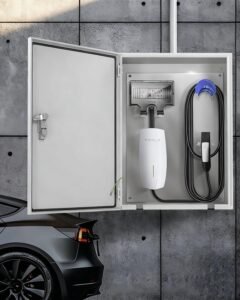
A national survey shows 24.4% of urban households live in flats. This means millions of EV drivers in India can’t simply plug in a charger at ground-level homes; instead, they must navigate complex rules in shared buildings.
The lack of convenient home charging in high-rise societies is already emerging as a key bottleneck to EV adoption. EV experts note that roughly 80% of EV charging happens at home (typically overnight), making accessible residential charging critical. Yet many housing societies are unprepared: some restrict charger installation due to safety or wiring concerns. There is little discussion about enabling home charging in India’s gated communities.
This guide answers the key questions facing Indian apartment EV owners and society managers:
-
What rules and permissions are needed to install an EV charger in an apartment?
-
What charging setups work best in Indian housing societies?
-
How much does it cost, and who pays?
What Rules And Permissions Are Needed To Install An EV Charger In An Apartment?
Installing EV chargers for apartment complexes involves several stakeholders: apartment owners (via the Resident Welfare Association, or RWA), the local electricity distribution company (DISCOM), and often municipal or building authorities. Fortunately, Indian government policy encourages, and in some cases mandates, EV charging for apartments in residential complexes. Key points include:
No Special License Needed
The Ministry of Power clarified in its EV Charging Guidelines that providing EV charging services does not require a separate electricity licence. In other words, you don’t need to become an “electricity supplier” to install a home charger; charging is treated as regular electricity use.
Building By-Laws Require EV Provisioning
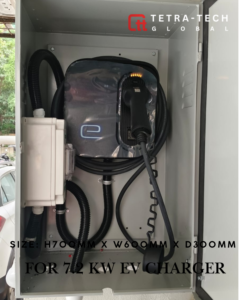
The Ministry of Housing & Urban Affairs (MoHUA) amended the national Model Building Bye-Laws (MBBL) in 2019 to require EV-ready infrastructure in parking areas. Per these rules, 20% of parking capacity in new buildings must be reserved for EV charging infrastructure. States like Maharashtra and Karnataka have adopted similar rules: e.g., Maharashtra mandates 10% EV-ready parking in new towers. This ensures future homes are “EV-ready,” but existing societies may need to retrofit wiring and parking to support residential EV charging stations.
RWA Permission / Governing Body Approval
In practice, any charger installation on society property needs RWA approval. Owners must pass an RWA resolution or AGM approval for dedicated charging points. RWAs can require EV owners to cover costs, but they should not arbitrarily block chargers. Some housing society bylaws have attempted to restrict EV chargers for non-technical reasons, but such restrictions conflict with government intent.
DISCOM Coordination
Once the RWA agrees, the DISCOM must be involved to supply power. Under the latest Ministry of Power guidelines, DISCOMs must supply electricity for EV charging through either the resident’s existing meter or a separate sub-meter, per the owner’s choice. Practically, this means:
-
Existing Meter: The EV charger draws power from the owner’s current apartment connection. The owner simply pays the extra usage on their usual bill.
-
Separate Meter: The RWA or owner installs a separate meter at the parking spot or a common distribution board, allowing access to special EV tariff rates (available in some states).
-
Sanctioned Load and Panel Upgrades: Many apartment complexes have limited power supply. If EV charging will push the load beyond the society’s sanctioned capacity, the RWA must apply to the DISCOM for a load increase. This often involves an engineer survey and fees for extra capacity. Internal wiring (distribution panels and feeders) may also need upgrading to safely handle the new chargers.
-
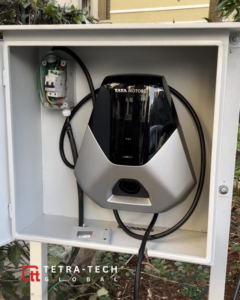
Safety and Technical Standards: EV chargers must meet Indian electrical safety standards. Guidelines require chargers to be BIS-certified and CEA-compliant. Installers should use industrial-grade cable, surge protection (as per BIS 17017), and residual current devices (RCDs). The RWA may ask for a certification from the installer confirming compliance with Bureau of Indian Standards specifications.
Government Guidelines & Legal Rights
-
Central Guidelines: The Bureau of Energy Efficiency’s 2024 EV Charging Guidelines explicitly include “Group Housing Societies” and “Residential Welfare Associations” as eligible locations. They direct DISCOMs to promptly provide new connections for EV charging and allow “community charging stations” set up by societies. Importantly, the guidelines ensure that private EV owners in housing societies have the right to install a charger at their parking spot.
-
Legal Rights: Under the Electricity Act and Supreme Court rulings, RWAs cannot unreasonably prevent EV charger installations if they comply with safety norms. Disallowing a resident from using their allotted parking slot for EV charging is generally not permissible.
Step-by-Step Installation Process
An apartment society should proceed as follows:
-
Form a Committee and Survey Demand: The RWA or EV-owning residents should survey how many owners want chargers and form a small EV committee.
-
Obtain RWA Approval: Pass a general-body resolution allowing charger installation.
-
Consult DISCOM: Ask the local power utility about requirements. They may survey the site to advise on meter installation, necessary load upgrades, and fees.
-
Apply for Connection / Load Upgrade: Request permission to connect (usually a NOC) or apply for a new connection or load enhancement within prescribed timelines (30–60 days).
-
Choose Equipment and Vendor: Approve a list of BIS-certified chargers and licensed contractors.
-
Electrical Upgrades: Install or upgrade panels, wiring, and meters.
-
Commissioning: Test each charger, ensure RCDs are functional, and update fire safety (e.g., fire extinguishers) and security measures (CCTV in parking).
-
Metering & Billing Setup: Decide billing mechanisms (direct DISCOM billing or RWA-managed cost-sharing).
What Charging Setups Work Best in Indian Housing Societies?
1. Private (Individual) Chargers
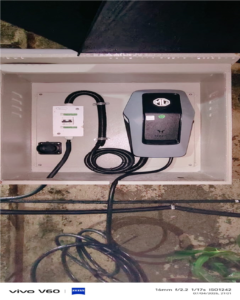
Each EV owner installs a charger at their own parking bay, usually an AC Level 2 charger (3.3–7.4 kW, 15–32A).
-
Pros: Simple, gives full owner control, and ties into the owner’s existing meter or a separate meter.
-
Best for: Early adopters or smaller societies with allocated parking spaces.
2. Community (Shared) Charging Stations
RWAs install charging points in common areas (slow AC or DC fast chargers). Residents use them via reservation or pay-per-use.
-
Pros: Spreads infrastructure costs, suits societies with unassigned parking, and allows community management (e.g., usage fees like ₹20 per kWh plus GST).
-
Smart Charging Networks: Larger societies are adopting IoT-enabled chargers with dynamic load management and pre-booking features, scalable for future growth.
Metering Models
-
Individual Sub-meters: Each charger (private or shared) has its own meter. In new connections, DISCOMs often offer dedicated EV tariffs.
-
Single Master Meter: All users draw from one meter, and the society manually divides consumption among EV owners.
How Much Does It Cost, and Who Pays?
Charger & Installation Costs
-
 Hardware: A basic AC home charger (3.3–7.4 kW) typically costs ₹40,000–₹50,000.
 -
Installation & Wiring: Adds another ₹15,000–₹20,000 (e.g., ₹40,000 charger + ₹10,000 installation + ₹6,000 wiring/meters = ₹56,000 total estimate for a 7.2 kW unit).
-
Grid/Panel Upgrades: Upgrading sanctioned load or transformers in older complexes can cost lakhs of rupees, often shared by owners or subsidized by state programs.
Electricity Tariffs
Home charging costs are lower than public fast charging:
-
If an EV consumes 7 kWh per night (~210 kWh/month), at ₹10/unit, it costs around ₹2,100 monthly.
-
Dedicated EV tariffs (e.g., ₹4–5/unit) offered by DISCOMs further reduce electricity expenses when paired with a separate meter.
Subsidies and Incentives by State
-
Delhi: Offers a subsidy of ₹6,000 per home charger under the Switch Delhi program, along with a special EV tariff rate of ₹4.50/unit and up to ₹30,000 subsidy per society for load upgrades.
-
Karnataka: Waived the 18% GST on EV chargers (bringing 7.2 kW charger prices down to ~₹35,000). Mandates 10% EV-ready parking in new developments.
-
Maharashtra: Provides road-tax and registration waivers for EVs, mandates 10% EV-ready parking in new towers, and encourages residential charger setups.
-
Tamil Nadu: Offers support and plans for fast-charging hubs alongside simplified utility frameworks.
Share This Article

Written by : Tetra Tech Global
Follow Us
Latest Articles
October 7, 2026
October 7, 2026
October 7, 2026
